
AICAR vs. MOTS-c: The Definitive Guide to AMPK Activation for Researchers & Biohackers

Disclaimer: The information provided in this article is strictly for educational and informational purposes. Both AICAR and MOTS-c are highly experimental, non-FDA-approved research chemicals. They are legally available strictly for Laboratory Research Use Only and are not intended for human consumption, diagnosis, treatment, or prevention of any disease.
Table of Contents
- 1. Introduction & Executive Summary
- 2. The Foundation: What is AMPK and Why Does it Matter?
- 3. Deep Dive: AICAR (5-Aminoimidazole-4-carboxamide ribonucleotide)
- 4. Deep Dive: MOTS-c (Mitochondrial-Derived Peptide)
- 5. AICAR vs MOTS-c: Core Mechanisms and Differences
- 6. Clinical Data and Efficacy in Metabolic Research
- 7. Performance and Endurance: The Advanced Biohacker’s Perspective
- 8. Research Protocols and Handling Considerations
- 9. Safety Profiles, Side Effects, and Long-Term Viability
- 10. Sourcing, Purity, and Laboratory Procurement
- 11. Frequently Asked Questions
- 12. Conclusion & Key Takeaways
1. Introduction & Executive Summary
The Pursuit of Metabolic Mastery
In the rapidly evolving landscapes of clinical biochemistry and advanced biohacking, few targets are as highly prized as the optimization of cellular bioenergetics. At the center of this pursuit lies the concept of metabolic flexibility—the cellular ability to seamlessly transition between substrate utilization (glucose versus fatty acids) based on demand and availability. Aging, sedentary lifestyles, and hypercaloric diets disrupt this machinery, leading to mitochondrial dysfunction, insulin resistance, and cellular senescence. To reverse this decline, researchers and elite biohackers have zeroed in on pharmacological interventions that trick the body into an optimized metabolic state. Two of the most potent, heavily researched compounds in this arena are AICAR and MOTS-c. While both are renowned for their ability to upregulate cellular energy pathways, their structural origins, pharmacokinetics, and ultimate physiological outcomes are drastically different.
Quick Answer: AICAR vs MOTS-c Explained
When evaluating aicar vs mots c, both compounds potently activate the AMPK pathway to optimize cellular bioenergetics, yet they operate via distinct mechanisms. AICAR acts as a direct AMP analog, explicitly targeting skeletal muscle to mimic intense cardiovascular exercise. Conversely, MOTS-c is a mitochondrial-derived peptide that regulates whole-body metabolic homeostasis and insulin sensitivity through indirect AMPK activation.
2. The Foundation: What is AMPK and Why Does it Matter?
The “Master Metabolic Switch”
To understand the profound implications of these compounds, one must first grasp the mechanics of AMPK (5′ AMP-activated protein kinase). AMPK is often referred to in molecular biology as the “master metabolic switch.” It is a highly conserved heterotrimeric kinase enzyme composed of three subunits: a catalytic $\alpha$ subunit, and regulatory $\beta$ and $\gamma$ subunits.
Its primary function is to serve as a fuel gauge for the mammalian cell. When a cell experiences metabolic stress—induced by hypoxia, nutrient deprivation, or intense exercise—ATP (adenosine triphosphate) is rapidly consumed and broken down to power cellular work.
The ATP/AMP Ratio
The critical trigger for AMPK activation is not just the depletion of ATP, but the subsequent rise in intracellular AMP (adenosine monophosphate). This relationship is governed by the adenylate kinase reaction:
$$2\text{ADP} \rightleftharpoons \text{ATP} + \text{AMP}$$
When the intracellular ATP/AMP ratio drops, AMP molecules bind to the regulatory Bateman domains (CBS domains) located on the $\gamma$ subunit of the AMPK complex. This binding induces a conformational change that accomplishes three vital tasks:
- It promotes the phosphorylation of the $\alpha$ subunit (at residue Thr172) by upstream kinases like LKB1.
- It allosterically activates the kinase, massively increasing its catalytic activity.
- It shields the complex from being dephosphorylated and deactivated by protein phosphatases.
Why Exogenous AMPK Activation is the Holy Grail
Activating AMPK without actually subjecting the body to the physical stress of fasting or exhaustive exercise represents a “holy grail” for both longevity researchers and biohackers. Exogenous activation stimulates mitochondrial biogenesis, increases glucose uptake in skeletal muscle independent of insulin, and forces the body to oxidize stored triglycerides for fuel.
3. Deep Dive: AICAR (5-Aminoimidazole-4-carboxamide ribonucleotide)
Chemical Structure and Discovery
AICAR, chemically classified as 5-aminoimidazole-4-carboxamide ribonucleotide, is a synthetic purine nucleoside analog. Originally synthesized in the 1980s, its clinical potential was historically explored for preserving blood flow to the heart during coronary bypass surgery. However, its true potential was uncovered when researchers identified its profound impact on skeletal muscle metabolism.
Mechanism of Action: The “Exercise Mimetic”
AICAR’s mechanism of action is brilliantly direct. Because of its structural similarity to adenosine, AICAR is readily taken up into the cytosol of the cell via adenosine transporters. Once inside, it undergoes phosphorylation by the enzyme adenosine kinase to form AICA-ribotide (also known as ZMP).
ZMP is the active metabolite. It functions as an intracellular mimic of endogenous AMP. ZMP binds directly to the $\gamma$ subunit of AMPK, inducing the exact same allosteric activation and Thr172 phosphorylation as natural cellular energy depletion. By tricking the cell into sensing a massive energy deficit, AICAR effectively “mimics” the biochemical signature of exhaustive endurance exercise without a single muscle contraction taking place.
Primary Target Tissues
While AMPK is ubiquitous across mammalian tissues, AICAR has a pronounced affinity for skeletal muscle. In groundbreaking murine studies, AICAR administration upregulated the transcription factor PPAR-$\delta$, driving the conversion of fast-twitch (Type IIb) muscle fibers into highly oxidative, fatigue-resistant slow-twitch (Type I) fibers.
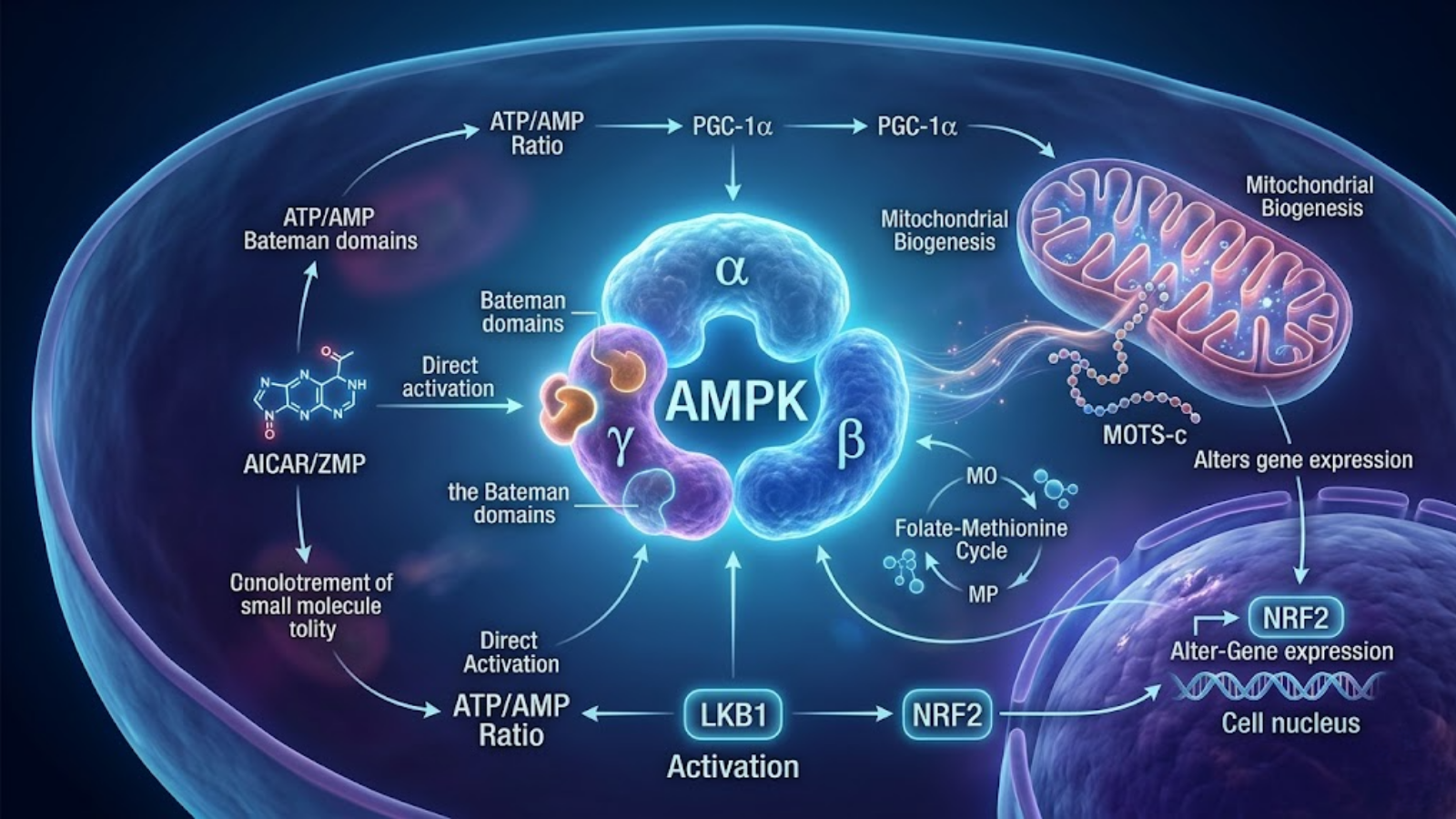
Conceptual visualization detailing the opposing activation pathways of AICAR (direct) and MOTS-c (indirect) centered around the AMPK complex.
4. Deep Dive: MOTS-c (Mitochondrial Open Reading Frame of the 12S rRNA-c)
What are Mitochondrial-Derived Peptides (MDPs)?
In stark contrast to the small-molecule nature of AICAR, MOTS-c represents a fascinating paradigm shift in cellular biology. We now understand that mitochondria are also signaling organelles, actively communicating with the cell nucleus—a process known as mitochondrial retrograde signaling. MOTS-c is a 16-amino acid peptide encoded not by the DNA in the cell’s nucleus, but by a small open reading frame within the mitochondrial genome itself.
Mechanism of Action: Systemic Metabolic Regulation
The mechanism of MOTS-c is highly complex and profoundly elegant. Under conditions of metabolic stress, MOTS-c translocates from the mitochondria to the nucleus, where it binds to specific transcription factors (such as NRF2) to regulate gene expression.
Crucially, MOTS-c activates AMPK indirectly. Laboratory data suggests that MOTS-c interacts with the folate-methionine cycle. By restricting the folate cycle, MOTS-c inhibits de novo purine biosynthesis. This localized inhibition leads to an endogenous accumulation of ZMP (the exact same active metabolite produced by AICAR administration). Therefore, MOTS-c naturally triggers the cell to produce its own AMPK-activating substrate.
The Role of MOTS-c in Aging and Cellular Senescence
Because MOTS-c is an endogenous peptide, circulating levels decline precipitously with age. Research indicates that restoring MOTS-c levels promotes systemic metabolic homeostasis. It is deeply implicated in reducing age-related insulin resistance, preventing diet-induced obesity, and mitigating cellular senescence.
5. AICAR vs MOTS-c: Core Mechanisms and Differences
Direct vs. Indirect AMPK Activation
The fundamental divergence in the aicar vs mots c debate lies in how they pull the metabolic trigger. AICAR acts as a blunt instrument: it brute-forces its way into the cell, converts to ZMP, and directly binds to AMPK. MOTS-c acts as an upstream systemic regulator: it alters the folate cycle, which secondarily causes a natural, highly regulated accumulation of ZMP to gently push AMPK activation.
Systemic vs. Tissue-Specific Targeting
AICAR’s effects are heavily localized to skeletal muscle and the liver, making it highly specific for endurance augmentation and rapid lipid oxidation. MOTS-c, conversely, acts as an endocrine factor. It circulates systematically, exerting profound effects on skeletal muscle, bone density, pancreatic tissue, and adipose tissue.
| Feature/Parameter | AICAR (Nucleoside Analog) | MOTS-c (Mitochondrial Peptide) |
|---|---|---|
| Molecular Classification | Synthetic small molecule | Endogenous peptide (16 amino acids) |
| AMPK Activation | Direct: Metabolizes into ZMP, which mimics AMP binding | Indirect: Alters folate cycle, triggering endogenous ZMP accumulation |
| Primary Biological Target | Skeletal muscle, Hepatic tissue (Liver) | Systemic (Muscle, Bone, Adipose, Pancreas) |
| Biological Half-Life | Extremely short (approx. 1-2 hours) | Short to moderate (extended downstream effects) |
6. Clinical Data and Efficacy in Metabolic Research (B2B Focus)
In Vivo Studies: AICAR’s Impact on Endurance and Obesity
The foundational literature surrounding AICAR is anchored by groundbreaking work from the Salk Institute. In seminal murine models, researchers discovered that administering AICAR to sedentary mice for four weeks increased their running endurance by a staggering 44% compared to vehicle-treated controls.
The researchers observed a profound genetic reprogramming within the skeletal muscle tissue. AICAR induced the upregulation of PPAR-$\delta$, leading to a physical shift in muscle composition: fast-twitch, glycolytic muscle fibers physically transitioned into slow-twitch, highly oxidative muscle fibers.
MOTS-c Trials: Insulin Resistance, Osteoporosis, and Longevity
While AICAR literature focuses heavily on brute-force endurance, MOTS-c research focuses on age-related metabolic decline and longevity. In controlled in vivo studies, MOTS-c administration in mice fed a high-fat diet completely prevented age-dependent and diet-induced insulin resistance. Furthermore, MOTS-c has been shown to regulate bone metabolism by stimulating osteoblast differentiation, making it a promising candidate for treating age-related frailties like osteoporosis.
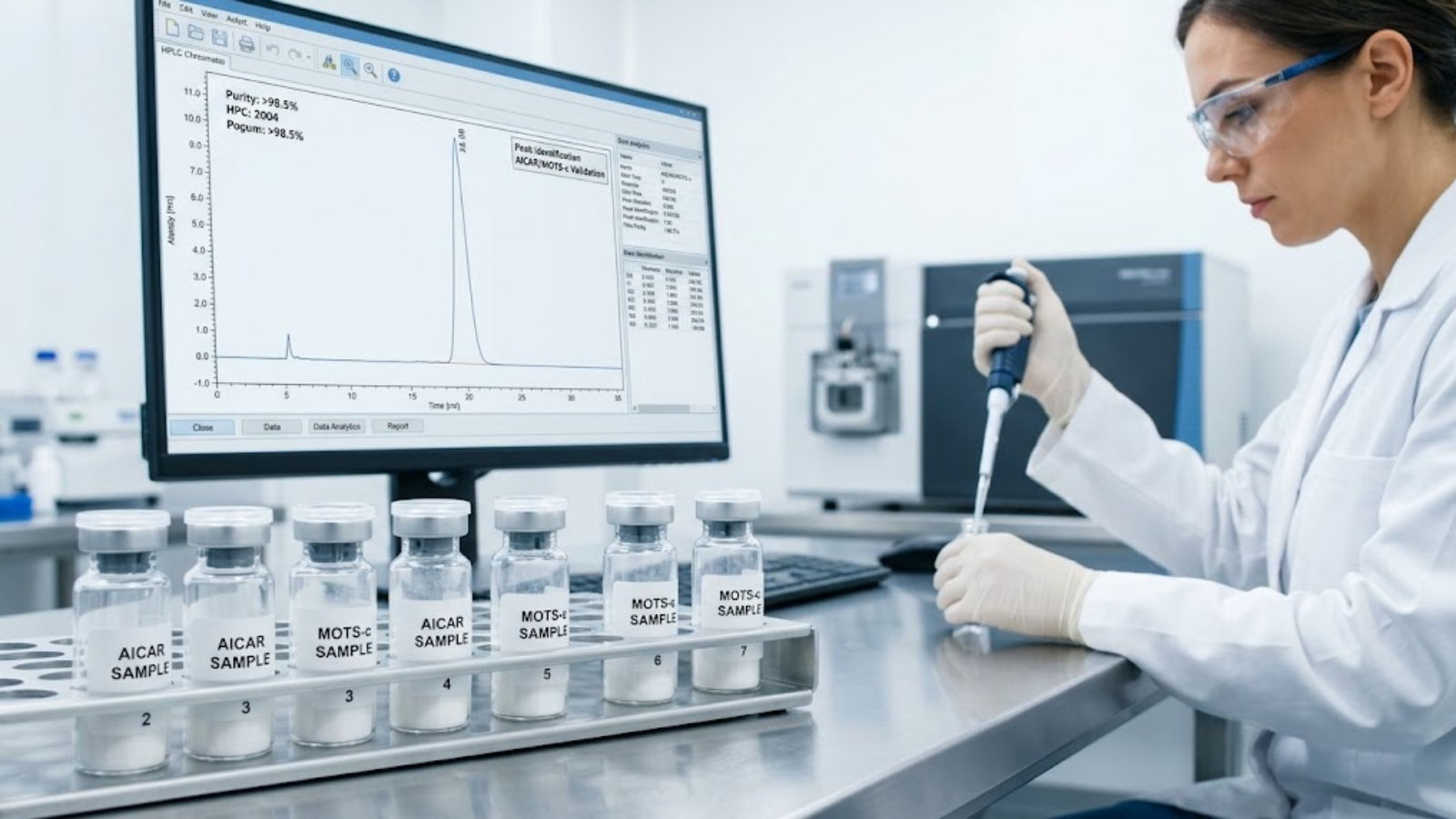
Professional clinical laboratory setting featuring an HPLC chromatogram monitor validating the purity parameters of synthesized research compounds.
7. Performance and Endurance: The Advanced Biohacker’s Perspective
Cardiovascular Endurance Optimization
For elite biohackers and endurance athletes, the holy grail is pushing the VO2 max ceiling and delaying the onset of lactic acid accumulation. When analyzing aicar vs mots c for immediate athletic performance, AICAR has historically been the primary tool. By forcing the cells into a state of perceived energy depletion, AICAR hyper-stimulates mitochondrial biogenesis, allowing users to sustain zone 2 and zone 3 cardiovascular output for significantly longer durations.
MOTS-c, conversely, does not typically provide the immediate “limitless” endurance feeling. Instead, its endurance benefits manifest over time through improved metabolic flexibility and mitochondrial repair.
Fat Oxidation and Body Composition
AICAR forces the body to prioritize fatty acid oxidation by increasing the expression of genes involved in lipid metabolism, essentially locking the body into a fat-burning state. MOTS-c is arguably the superior compound for holistic body recomposition, enhancing insulin sensitivity and driving glucose into the muscle tissue rather than storing it as visceral fat.
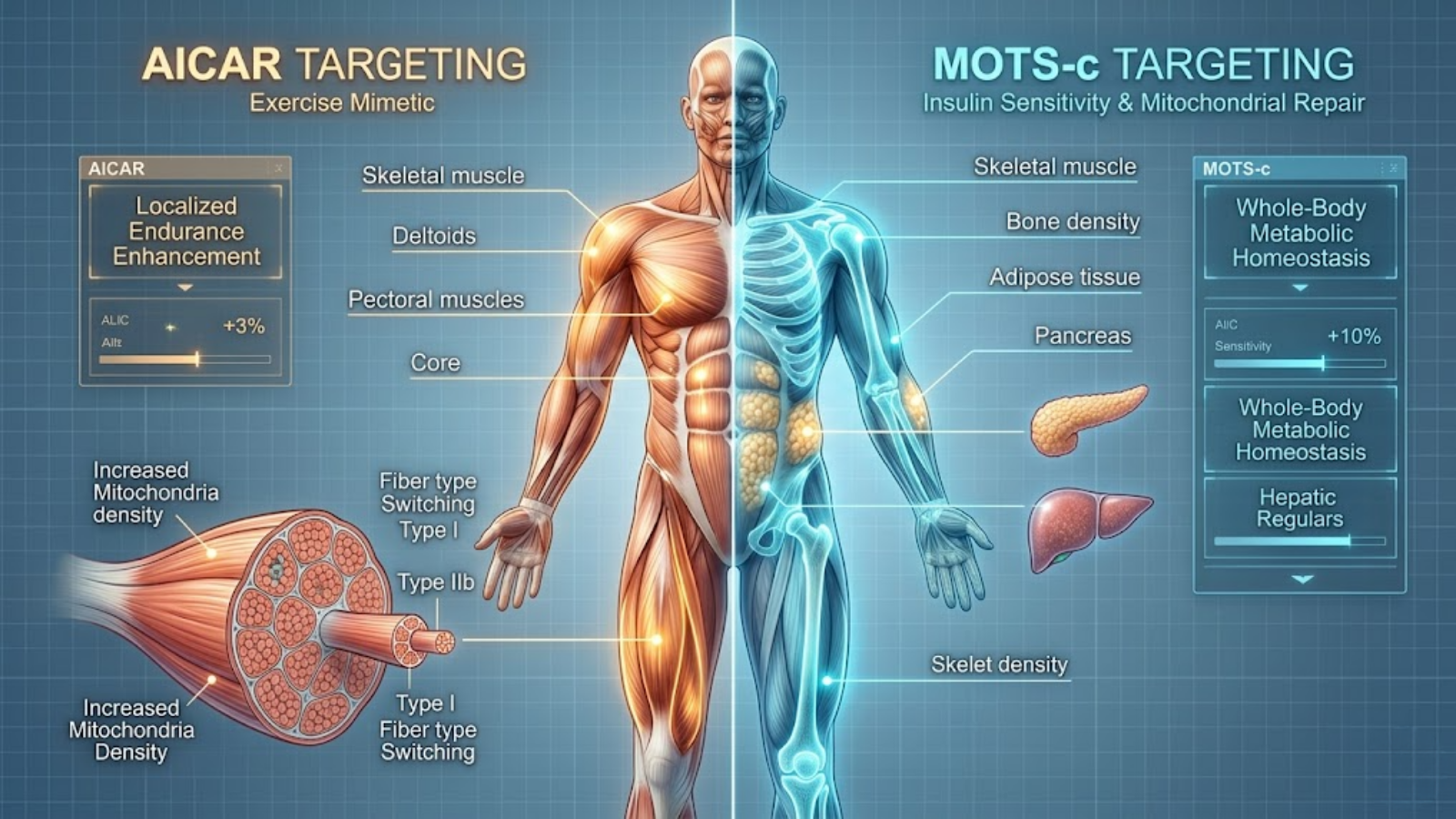
Anatomical targeting map demonstrating AICAR’s localized skeletal muscle effects versus the systemic, whole-body homeostasis promoted by MOTS-c.
8. Research Protocols and Handling Considerations
Standard Laboratory Reconstitution
Proper handling is paramount, particularly for MOTS-c, which is a fragile peptide. Both compounds are typically acquired as lyophilized (freeze-dried) powders requiring reconstitution before subcutaneous administration. Bacteriostatic water (BAC water) containing 0.9% benzyl alcohol is the standard solvent.
Experimental Dosing Schedules
Because AICAR is a small molecule with a massive molecular weight requirement, and MOTS-c is a highly signaling peptide, their dosing protocols are vastly different. AICAR’s massive dosing requirement is a significant barrier to entry, whereas MOTS-c operates efficiently at micro-gram to milli-gram levels.
Storage and Degradation Parameters
Both compounds should be stored at -20°C (freezer) in their lyophilized state. Once mixed with BAC water, MOTS-c degrades rapidly and must be kept at 2°C to 8°C (refrigerated) and used within 14 to 20 days. AICAR must also adhere to strict cold-chain storage to prevent compound degradation.

Advanced metabolic protocol flat lay featuring lyophilized peptide vials, reconstitution solvents, and clinical logbooks used in advanced biohacking regimens.
9. Safety Profiles, Side Effects, and Long-Term Viability
Known Side Effects of AICAR
- Lactic Acidosis: By forcefully ramping up glycolysis and lipid oxidation, AICAR can cause a dangerous accumulation of lactic acid in the blood.
- Cardiac Hypertrophy: Chronic, unregulated activation of AMPK in cardiac tissue can lead to heart enlargement.
Immunological Responses to MOTS-c
MOTS-c has a remarkably high safety profile, largely because it is an endogenous peptide. However, exogenous administration carries risks of injection site reactions and a minor risk of anti-drug antibodies neutralizing its efficacy over time.
The Danger of Hyper-Activation: The AMPK/mTOR See-Saw
mTOR is the primary driver of anabolism (muscle growth, protein synthesis), while AMPK is the driver of catabolism. When AMPK is highly activated by AICAR or MOTS-c, mTOR is forcefully suppressed. Therefore, running continuous, year-round protocols of AMPK activators will severely blunt muscle hypertrophy.
10. Sourcing, Purity, and Laboratory Procurement
The peptide and research chemical market is notoriously unregulated. Because AICAR is incredibly expensive to synthesize, it is highly counterfeited. Whether you are a B2B procurement officer or a biohacker, demanding independent verification via HPLC (High-Performance Liquid Chromatography) and Mass Spectrometry (MS) is non-negotiable. Always procure these compounds in lyophilized powder format, as pre-mixed solutions degrade rapidly.
11. Frequently Asked Questions
Which is better for cardiovascular endurance, AICAR or MOTS-c?
For acute, massive increases in raw cardiovascular stamina, AICAR is generally considered more potent due to its direct action on skeletal muscle. However, MOTS-c provides superior long-term endurance benefits by repairing systemic mitochondrial dysfunction and improving overall metabolic flexibility without the heavy side-effect profile of AICAR.
Can you stack AICAR and MOTS-c together?
While theoretically possible, stacking AICAR and MOTS-c simultaneously is generally not recommended in standard research protocols. Because both compounds aggressively upregulate the AMPK pathway, using them concurrently risks severe metabolic stress, excessive mTOR suppression, and potential lactic acidosis. They are best utilized in alternating cycles.
How long does it take to see results from a MOTS-c research cycle?
In most clinical and anecdotal models, physiological responses to MOTS-c begin at the cellular level immediately, but noticeable systemic results take time. Improvements in insulin sensitivity, baseline energy, and endurance typically manifest between weeks three and four of a consistent, well-structured research protocol.
Is AICAR detectable in standard athletic drug testing?
Yes, AICAR is explicitly banned by the World Anti-Doping Agency (WADA) and is detectable in standard blood and urine tests. Specialized mass spectrometry techniques can easily differentiate between endogenous AMP levels and the synthetic ZMP metabolite produced by exogenous administration.
12. Conclusion & Key Takeaways
Summary of the Science
The quest to control the AMPK pathway represents the bleeding edge of metabolic science. When evaluating aicar vs mots c, we are looking at two vastly different tools designed to accomplish a similar goal: surviving metabolic stress and optimizing cellular energy output. AICAR is a synthetic hammer—rapidly forcing skeletal muscle into a state of hyper-endurance. MOTS-c is a biological scalpel—an endogenous mitochondrial peptide that orchestrates a systemic, holistic repair.
Key Takeaways
- Mechanistic Difference: AICAR is a direct AMPK activator, while MOTS-c is an indirect activator (modulating the folate cycle).
- Target Tissues: AICAR targets skeletal muscle and liver tissue; MOTS-c exerts an endocrine-like effect, regulating muscle, bone, and systemic insulin sensitivity.
- Practical Application: AICAR requires massive, expensive dosing. MOTS-c operates efficiently at the micro-gram to milli-gram level.
- Safety & Cycling: Both compounds suppress mTOR (muscle growth) and must be cycled to prevent catabolic wasting.
- Procurement: Always insist on lyophilized powders backed by current, batch-specific third-party HPLC and Mass Spectrometry testing.